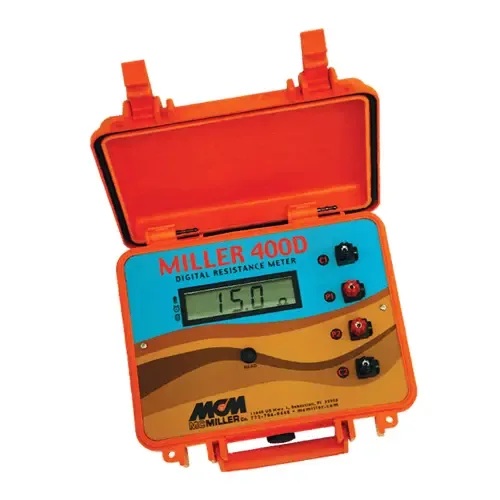
Soil resistivity meters
The M.C. Miller 400A and 400D measure resistance. In a four-pin Wenner survey, soil resistivity is calculated using the measured resistance and the pin spacing.
In a Wenner survey, four equally spaced pins are placed in a straight line. The outer pins carry the test current and the inner pins measure the potential difference. Soil resistivity is expressed in Ω·m.
P.Z.A. CORRSTOP Sp. z o.o. is a direct distributor of M.C. Miller, USA, a leading manufacturer of cathodic protection products.
M.C. Miller resistance meters
CORRSTOP supplies the M.C. Miller 400A and 400D. Together, these models cover resistance measurements from 0.01 Ω to 10 MΩ. With the appropriate calculation, the readings can also be used to determine soil resistivity.
What is soil resistivity?
Soil resistivity describes how strongly soil opposes electrical current flow. It is represented by ρ (rho) and expressed in ohm-metres (Ω·m). Lower resistivity means better conductivity. This value is important when designing cathodic protection and measures against AC interference on pipelines, and when assessing soil corrosivity. It must be measured using suitable instruments.
The widely used Wenner method employs four identical probes placed in a straight line at equal spacing L. A voltage source connected to the outer probes drives current through the soil. The measured current and the voltage between the inner probes give the resistance R in ohms. Combining this resistance with probe spacing L gives the soil resistivity.
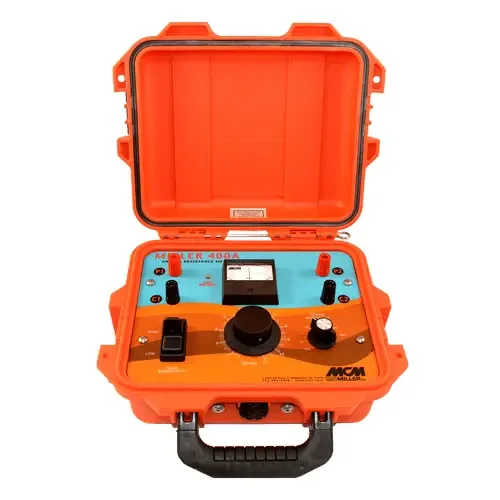
M.C. Miller 400A
The M.C. Miller 400A is an analogue resistance meter valued for its straightforward operation and reliability. Its light, rugged, weather-resistant case makes it suitable for demanding field conditions.
Measurement range: 0.01 Ω to 1.1 MΩ.
The source is a 12 V RMS quartz oscillator producing a 97 Hz square wave. The internal voltmeter uses a very narrow band-pass filter tuned to this frequency.
This makes resistance measurements resistant to interference from stray currents and signals at other frequencies that may be present in the soil.
- Moisture-resistant case for use on wet ground.
- Removable lid to simplify moving between measurements with the leads connected.
- Replaceable C-size alkaline batteries; no charging or mains supply required.
M.C. Miller 400D
The M.C. Miller 400D is a digital resistance meter combining automatic operation with a wide measurement range. Its digital display and automatic range selection provide a direct resistance reading at the press of a button, without manual adjustment.
Measurement range: 0.01 Ω to 10 MΩ, with automatic range selection.
The source is a 12 V RMS quartz oscillator producing an 82.2 Hz square wave. The built-in ammeter and voltmeter use very narrow band-pass filters tuned to this frequency.
This rejects signals at other frequencies that may be present in the soil during the measurement.
- High-resolution digital display.
- Computer connection and measurement logging.
- Impact-resistant, moisture-resistant plastic case for field use.
- Replaceable D-size alkaline batteries, providing up to 10,000 measurements per set.