Corrosion monitoring
Electrical resistance (ER) probes and a portable meter track metal loss and corrosion rates in soil.
What is corrosion monitoring?
In the cathodic protection criterion described in PN-EN 12954, the protection potential Ep corresponds to a metal corrosion rate below 0.01 mm per year. The criterion is expressed as E ≤ Ep.
Protection potential values refer to potentials without the ohmic component. Measuring the potential of a buried structure is considerably easier than measuring corrosion rate, so potential measurements are a principal source of information on pipeline cathodic protection.
In the field, measured potentials, including OFF potentials, are often only approximations to IR-free potentials. Errors may result from equalising currents between coating defects with different polarisation levels after the cathodic protection system is switched off, or from stray currents. ON and OFF potential readings also do not establish whether a pipeline is protected against AC corrosion caused by nearby overhead high-voltage lines.
What are electrical resistance corrosion probes?
ER probes use the increase in electrical resistance of a buried metal element as corrosion progresses. This reflects the combined corrosive effects acting on its surface. Measurements over a known period determine metal loss and corrosion rate, which can be compared with the criterion of less than 0.01 mm per year.
Probes are buried close to the pipeline, in a similar way to Cu/CuSO₄ reference electrodes. Their multicore measurement cables run to a test station, where dedicated readers are used to measure metal loss and corrosion rate.
Although their precision construction makes corrosion probes relatively costly, they have been used increasingly for more than twenty years to assess cathodic protection effectiveness and external corrosion risks on pipelines.
ER0500 series probes
ER0500 corrosion probes are designed for demanding operating conditions and long-term monitoring of the corrosion rate of buried pipelines, tanks and other steel structures, with or without cathodic protection.
The probe reproduces the conditions on an exposed metal surface or at a coating defect. Its protected reference element provides stable, accurate measurements throughout the probe's service life.
A bonding lead can connect the probe electrically to the cathodically protected structure, allowing protection effectiveness to be assessed during normal operation. When disconnected, the probe measures the corrosivity of the surrounding soil.
The bonding lead is normally connected near the measurement connector, so the structure can be connected or disconnected without disturbing the buried probe.
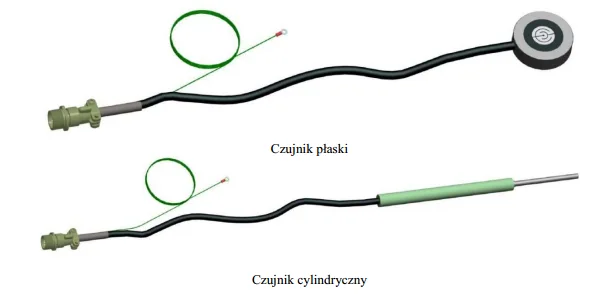
The flush probe represents a coating defect. The cylindrical probe fits locations with restricted access, including reinforced concrete structures. Both have a protected reference element.
MS4500E portable reader
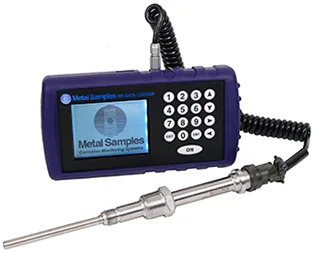
The MS4500E is a portable, battery-powered corrosion meter compatible with all types of ER (Electrical Resistance) corrosion probes. It measures, records and supports analysis of corrosion rates in metal structures.
Its compact, lightweight construction, microprocessor control, keypad-operated menu and backlit graphical LCD support day-to-day field and laboratory work.
The MS4500E also serves as a high-resolution data logger:
- It records metal loss in mils and corrosion rate in mils per year (mpy).
- Every measurement is automatically time- and date-stamped.
- Readings are stored in non-volatile Flash memory, with no battery backup required.
The memory supports:
- up to 16,000 readings per probe,
- up to 250 probes, approximately four million records in total.
Data can be:
- viewed directly on the reader's screen,
- exported to a USB storage device,
- analysed and plotted using dedicated software or standard analytical tools, including spreadsheets.